Four Girder vs Double Girder Ladle Cranes: Indian Steel Guide
menu_open
Content Quick Link
Four Girder vs Double Girder Ladle Cranes: Which Is Right for Indian Steel Mills?
Most Important Takeaway
For Indian steel mills, the right ladle crane—double girder or four girder—depends on load capacity, operational reliability, shop layout, and duty frequency, not just upfront cost. Choosing wisely safeguards production continuity, minimizes downtime, and builds long-term trust with your workforce and suppliers.
Key Takeaways
- Double girder ladle cranes are cost-effective, easier to maintain, and ideal for moderate-capacity operations in smaller steel shops.
- Four girder ladle cranes provide high rigidity, handle very heavy ladles reliably, and suit large, high-volume operations.
- Typical project locations in India include Jharkhand, Chhattisgarh, West Bengal, Odisha, and Karnataka, where steel production and expansion projects demand reliable ladle cranes.
The choice solves questions like:
- Which crane type supports high-capacity molten steel handling safely?
- How does shop layout and span influence crane selection in Indian steel plants?
- What offers better long-term reliability under harsh conditions like high temperature, dust, and frequent duty cycles?
Ladle Cranes in Indian Steel Mills
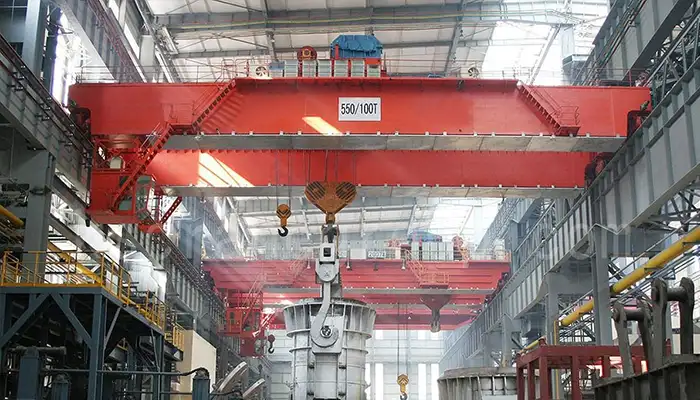
Ladle cranes play a central role in steelmaking operations. They are responsible for lifting, moving, and positioning molten steel ladles in BOF, EAF, and LF shops. In India, steel production is expanding quickly, and mills are handling larger volumes than ever before. A crane that cannot keep up with the demands of heavy loads and frequent transfers will cause delays—and delays in steel production cost real money.
A good ladle crane isn’t just about lifting heavy loads. It’s about precision, safety, and reliability under extreme conditions. Indian steel mills often operate in high-temperature environments, with dust, smoke, and occasional power fluctuations. The right crane must withstand all of this while keeping operations smooth.
Why practical reliability matters:
- Downtime during a peak production shift can cost more than the difference in initial crane investment.
- Choosing a robust, well-engineered crane ensures fewer maintenance issues and longer service life.
- Operators and supervisors trust equipment that performs consistently, which improves overall productivity and morale.
Key considerations when selecting ladle cranes in India:
- Lifting capacity: Choose a crane that can handle your heaviest ladle plus a safety margin of 20–30%.
- Duty cycle: Frequency of ladle movements matters; cranes must be rated for high-duty cycles in busy BOF and EAF shops.
- Structural rigidity: For large spans and heavy loads, cranes must resist deflection to prevent accidents or equipment damage.
- Environmental protection: Motors, wires, and control systems must withstand high heat, dust, and occasional humidity.
- Ease of maintenance: Indian mills often prefer cranes that are straightforward to service with available local technicians.
Practical tip: Don’t just look at the tonnage on paper. Observe your plant conditions, your floor layout, and how often ladles need to be moved. A crane that fits well into your operations and is easy to maintain often saves more money over five years than a slightly cheaper crane that fails more often.
In short, ladle cranes in Indian steel mills are more than lifting machines—they are the backbone of molten steel handling. Investing in the right crane today ensures smoother production, safer operations, and long-term peace of mind for both management and staff.
Double Girder Ladle Cranes
Double girder ladle cranes are widely used in Indian steel mills for handling medium-capacity molten steel ladles. They strike a balance between cost, reliability, and operational efficiency, making them a practical choice for many plants, especially smaller shops or expansion projects.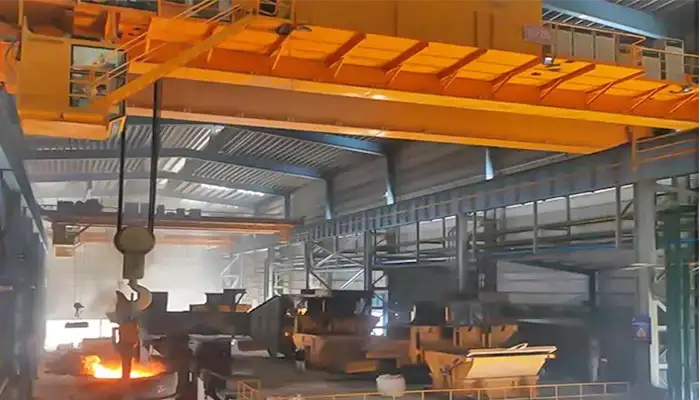
Design & Features
Double girder cranes are designed with a focus on simplicity and structural efficiency. Their configuration allows them to handle moderate loads effectively while being easy to install and integrate into typical shop layouts.
- Two main girders support the hoist and trolley. This design distributes the load efficiently while maintaining a straightforward structure.
- Simpler structure, lighter footprint. The crane requires less headroom, making it suitable for plants with limited vertical space.
- Moderate spans, suitable for mid-size furnaces. While not ideal for extremely wide furnaces, these cranes cover most medium-scale steelmaking needs reliably.
Practical note: The lighter footprint and simpler installation reduce stress on runway beams and can lower civil work costs.
Typical Capacity in India
When selecting a double girder ladle crane, capacity is the first consideration. Indian mills generally use these cranes for medium-scale operations where extreme heavy lifting isn’t frequent.
- 20–50 tons for standard operations such as rebar and billet handling.
- Up to 75 tons for moderate-duty ladle handling in BOF, LF, or smaller EAF shops.
Business insight: These capacities cover the majority of medium-scale operations in India, providing adequate flexibility without over-investment.
Advantages
Double girder cranes are particularly appealing because they combine practicality and operational ease. They provide reliable service without the higher costs or complexity of four girder designs.
- Lower initial investment. For cost-conscious operations or expansions, these cranes meet needs without excessive capital outlay.
- Easier maintenance. The simple design allows local technicians to perform routine inspections and repairs efficiently.
- Sufficient for medium-capacity ladles. Ideal for rebar, billet, or small BOF shops, they deliver consistent performance without over-engineering.
Indian mills often favor equipment that is trustworthy and low-maintenance, allowing operations to run smoothly day after day.
Limitations
While versatile, double girder cranes have operational constraints that must be considered during planning, especially in heavy-duty or high-frequency steel production.
- Limited rigidity under very heavy loads. The crane may flex slightly when handling extremely large ladles, affecting precision and safety.
- Not ideal for very wide spans or high-frequency molten steel operations. Longer travel distances or rapid cycles may require a four girder alternative.
Practical note: Understanding these limits helps avoid unplanned downtime and ensures safe, efficient operation.
Typical Project Locations
Double girder ladle cranes are widely used in industrial regions across eastern and central India. They are well-suited for areas with medium-capacity steel production where operational simplicity and cost-effectiveness are valued.
- Jharkhand – Growing industrial hubs with medium-scale BOF and billet operations.
- Chhattisgarh – Expansion projects and rebar mills favor these cranes for reliability.
- West Bengal – Steel shops where simplicity and predictable maintenance are important.
Many Indian operators prefer equipment that just works reliably every day. Double girder cranes often become the quiet backbone of operations, handling ladles efficiently without constant attention.
Practical Tip for Indian Mills
Double girder cranes are ideal for smaller shops or incremental expansion projects. They offer predictable maintenance, manageable costs, and operational reliability, making them suitable for plants where budget, floor space, and simplicity are key.
Four Girder Ladle Cranes
Four girder ladle cranes are designed for heavy-duty operations where high capacity, long spans, and minimal deflection are essential. These cranes are often chosen in India for large BOF, EAF, and LF shops, where molten steel handling demands the highest reliability and precision. While the initial investment is higher, they provide long-term operational security for critical steelmaking processes.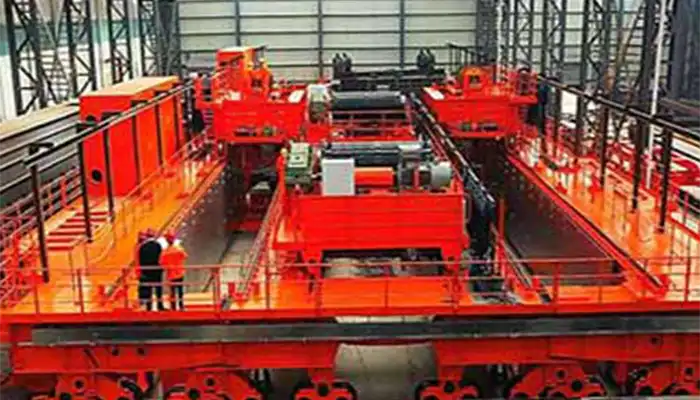
Design & Features
The design of four girder cranes focuses on strength and rigidity. They are engineered to carry the heaviest ladles over longer spans while keeping movements stable and predictable.
- Four girders distribute heavy loads with minimal deflection. This ensures structural stability even when handling the largest ladles.
- Supports very large hoists and longer spans. Ideal for high-capacity operations and plants with wide furnace layouts.
- Provides higher structural rigidity and operational safety. The robust design minimizes sway and ensures smooth, precise positioning of molten steel ladles.
While they require more headroom and stronger runway structures, the increased rigidity protects both equipment and operators during continuous heavy-duty operation.
Typical Capacity in India
When evaluating four girder cranes, capacity and duty cycle are key. Indian mills with large-scale operations demand cranes that can handle frequent, heavy lifts without compromising safety or production efficiency.
- 60–200 tons for heavy-duty BOF, EAF, and LF operations.
- Can support large lifting trolleys and magnetic handling systems. Useful for integrated steel shops handling various steel products simultaneously.
Business insight: For high-volume operations, four girder cranes provide the flexibility to manage multiple heavy ladles efficiently, keeping production smooth during peak shifts.
Advantages
Four girder cranes excel in environments where reliability under stress and safety are non-negotiable. They are often the go-to choice for large steel shops in India.
- Handles high-capacity molten steel ladles reliably. Even the heaviest ladles can be lifted with minimal deflection.
- Reduces deflection under extreme loads, protecting both ladle and infrastructure. This extends the life of equipment and reduces maintenance interruptions.
- Suitable for frequent, heavy-duty operations in large steel shops across India. Ideal for plants running multiple shifts with continuous ladle handling.
Indian mills often view four girder cranes as a long-term investment. While the upfront cost is higher, the consistent operation and reduced risk of downtime often justify the price.
Limitations
Despite their advantages, four girder cranes come with operational considerations that must be planned for in advance.
- Higher upfront cost, requiring careful budgeting. Capital investment is significant, especially for large spans and heavy capacities.
- More complex maintenance; requires trained personnel. Maintenance teams must be familiar with more advanced mechanical and electrical systems.
- Needs adequate headroom and robust supporting structures. Plants with limited space or weak runway beams may require additional civil work.
Business insight: Planning for these limitations upfront can prevent costly retrofits and production delays later.
Typical Project Locations
Four girder cranes are most commonly used in high-volume steel hubs and regions with major expansion projects. They are particularly well-suited for large plants where heavy-duty, continuous operations are the norm.
- Odisha – Industrial regions with large-scale BOF/EAF operations.
- Karnataka – Expanding steel hubs where reliability under heavy loads is critical.
- Central and eastern industrial regions – Areas with multiple integrated steel facilities handling large molten steel volumes.
In these regions, mills often value long-term reliability and operational safety over lower upfront costs, making four girder cranes a preferred choice.
Practical Tip for Indian Mills
Four girder cranes are worth the investment in high-volume operations. They reduce the risk of downtime, protect equipment and staff, and provide the stability needed to manage continuous molten steel handling efficiently. For Indian steel mills aiming for consistent production and minimal disruptions, four girder cranes often pay off in the long run.
Side-by-Side Comparison
When choosing between double girder and four girder ladle cranes, it helps to see how they compare across key operational factors. Indian steel mill managers often face the challenge of balancing capital investment with reliability, so understanding the practical differences is essential.
Before diving into the comparison, keep in mind that the right choice depends not just on crane capacity, but also on shop layout, duty frequency, and local environmental conditions like heat, dust, and high operational cycles.
| Feature | Double Girder | Four Girder |
|---|---|---|
| Load capacity | 20–75 tons | 60–200 tons |
| Rigidity | Medium | Very High |
| Span | Medium | Long/Wide |
| Initial cost | Lower | Higher |
| Maintenance | Easier | Complex |
| Typical application in India | Medium-capacity shops | Heavy-duty, high-frequency operations |
| Common regions | Jharkhand, Chhattisgarh, West Bengal | Odisha, Karnataka, central/eastern industrial hubs |
After reviewing the comparison, it becomes clear that double girder cranes excel where operational simplicity, lower upfront cost, and moderate capacity are the priorities. They integrate well into smaller shops or expansion projects where downtime must be minimized, and maintenance teams are less specialized.
On the other hand, four girder cranes are built for heavy-duty, high-frequency operations. Their higher rigidity and longer span make them suitable for larger shops and regions with heavy molten steel handling. Although the initial investment is higher and maintenance more complex, the reliability and safety under extreme loads often justify the cost in large-scale Indian steel operations.
For Indian steel mill managers, the decision comes down to weighing initial cost versus operational security. A slightly higher upfront investment in a four girder crane can prevent downtime, protect expensive equipment, and maintain production schedules—an outcome that pays off over time in high-demand environments.
Local Considerations for Indian Steel Mills
When selecting a ladle crane, it’s not just about capacity or cost. Indian steel mills face unique operational challenges that influence which crane type works best. Understanding these local factors can save both money and downtime, while improving overall plant efficiency.
Before we go into specifics, consider that many mills in India operate under space constraints, heavy duty cycles, and environmental stressors. Each of these factors plays a role in whether a double girder or four girder crane is the smarter choice for your plant.
- Shop layout: Many Indian BOF and EAF shops have limited space, making crane installation tricky. Double girder cranes generally fit better into compact layouts and require less headroom, simplifying integration.
- Duty cycles: Frequent ladle transfers demand a crane that can perform consistently without bending or deflection. In these situations, four girder cranes provide the rigidity needed to handle heavy, repetitive lifts safely.
- Environmental conditions: High temperatures, dust, and occasional humidity are common in Indian steel shops. Cranes with protective housings, insulated wiring, and heat-resistant motors are essential for long-term performance.
- Cost vs long-term reliability: Indian mills often weigh upfront capital expenditure against the risk of downtime. While four girder cranes cost more initially, their robust design can prevent costly production delays, making them economically sensible in the long run.
After considering these factors, it’s clear that the right crane choice is a balance. Some shops benefit from the simplicity and lower cost of double girder cranes, while others require the heavy-duty reliability of four girder designs.
In India, trust and long-term relationships are central to business. Choosing a crane that performs reliably day after day strengthens confidence among operators, contractors, and suppliers alike. Reliable equipment doesn’t just lift steel—it builds credibility, fosters smoother operations, and maintains your reputation in the local industry.
Conclusion – Choosing the Right Ladle Crane for Indian Steel Mills
Selecting a ladle crane is not just a technical decision—it’s a strategic choice that affects productivity, safety, and long-term operational costs. In India, where steel mills face space constraints, high temperatures, and heavy-duty production cycles, the right crane makes a tangible difference.
Key Points to Remember
Double girder ladle cranes
- Best for mid-capacity operations with moderate spans.
- Easier to maintain and integrate into smaller shops or expansion projects.
- Ideal when cost-effectiveness and simplicity are priorities.
Four girder ladle cranes
- Designed for heavy-duty, high-frequency operations.
- Superior rigidity reduces deflection and protects both ladles and infrastructure.
- A long-term investment for large-scale plants where reliability cannot be compromised.
Practical Considerations
- Align crane selection with your plant layout, duty cycles, and local environmental conditions.
- Evaluate short-term costs versus long-term operational security—downtime or maintenance issues can outweigh initial savings.
- Consider trust and operator confidence: a crane that works reliably every day builds credibility across your team, contractors, and suppliers.
Final Takeaway
The right ladle crane is more than equipment. It’s a partner in production, ensuring smooth operations, protecting your workforce, and supporting consistent steel output. In Indian steelmaking, practical solutions and reliability are what keep a plant running—and a business thriving.

Article by Bella ,who has been in the hoist and crane field since 2016. Bella provides overhead crane & gantry crane consultation services for clients who need a customized overhead travelling crane solution.Contact her to get free consultation.